
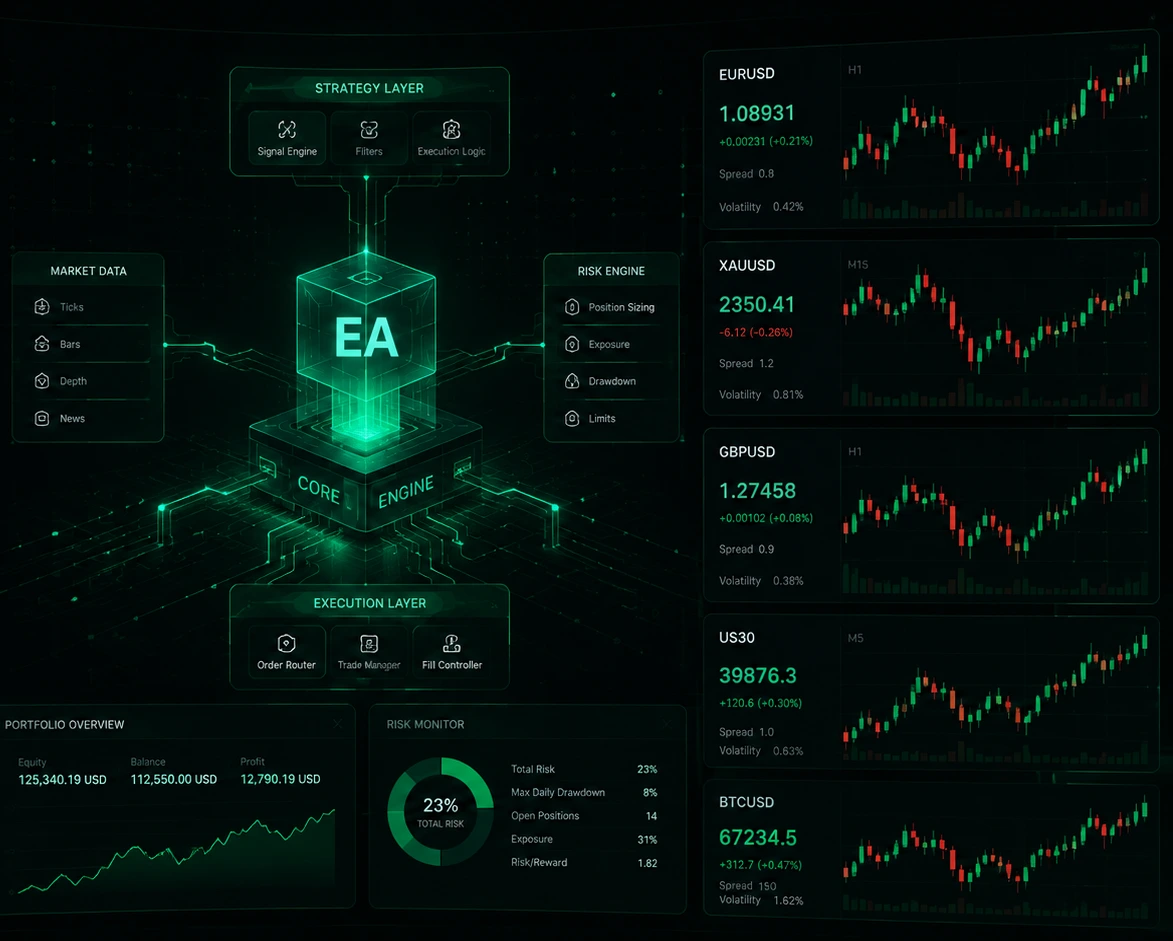
A single-symbol Expert Advisor can be surprisingly simple. It receives a tick, checks a few conditions, calculates a position size, and sends an order.
But the moment that same strategy needs to monitor 10, 20, or 50 instruments, the problem changes completely.
You are no longer building a trading script. You are building a small event-driven trading system.
A serious multi-symbol EA has to manage independent market states, indicator data, order execution, portfolio exposure, broker restrictions, position lifecycle, and recovery after failures — often at the same time.
In this article, we will look at how to structure a scalable multi-symbol
Expert Advisor in MQL5 without turning the project into one massive
OnTick() function that becomes impossible to maintain.
Why a Simple Loop Is Not Enough
The first idea many developers have is something like this:
for(int i = 0; i < ArraySize(symbols); i++)
{
    CheckSignal(symbols[i]);

    if(SignalExists(symbols[i]))
        OpenTrade(symbols[i]);
}
For a prototype, this may work.
For a production system, it creates several problems very quickly.
Each symbol can be in a completely different state. EURUSD may already have an active position. GBPJPY may have a pending trade request. XAUUSD may not have enough historical data loaded yet. Another symbol may be outside its trading session.
Treating all of them as identical items inside a loop hides this complexity instead of managing it.
The better approach is to give every symbol its own state.
1. Build a Context for Every Symbol
A multi-symbol system becomes much easier to reason about when every instrument has its own context object or structure.
For example:
struct SymbolContext
{
    string symbol;
    ENUM_TIMEFRAMES timeframe;

    datetime last_bar_time;

    int fast_ma_handle;
    int slow_ma_handle;
    int atr_handle;

    bool signal_ready;
    bool order_pending;
    bool position_active;

    double planned_entry;
    double planned_sl;
    double planned_tp;
};
Then the EA can maintain an array:
SymbolContext markets[];This may look like a small architectural decision, but it changes the entire design.
Instead of using global variables such as:
bool signal;
datetime last_bar;
double stop_loss;
the system now knows exactly which symbol owns each piece of state.
That prevents one market from accidentally influencing another market's logic. It also makes debugging dramatically easier because every decision can be tied to a specific context.
2. Do Not Let One Chart Control the Entire Portfolio
One of the most important details in a multi-symbol EA is event scheduling.
An Expert Advisor attached to EURUSD receives OnTick() when the
chart symbol receives a tick. That does not mean every other symbol in your
portfolio has just received fresh market data.
If the architecture depends entirely on the host chart's ticks, the frequency of strategy evaluation can unintentionally depend on a completely unrelated instrument.
For many multi-symbol systems, a timer-based scheduler provides a cleaner foundation.
int OnInit()
{
    EventSetTimer(1);

    return INIT_SUCCEEDED;
}
The portfolio can then be processed independently:
void OnTimer()
{
    for(int i = 0; i < ArraySize(markets); i++)
    {
        ProcessMarket(markets[i]);
    }

    UpdatePortfolioRisk();
    ManageOpenPositions();
}
This does not mean OnTimer() should always replace
OnTick().
A high-frequency system may require a different event model. But for many bar-based or medium-frequency strategies, an explicit scheduler is much more predictable than allowing the host chart to decide when the complete portfolio is evaluated.
3. Detect New Bars Per Symbol — Not Globally
Imagine the strategy runs on H1 candles.
A common mistake is storing one global last_bar_time. In a
multi-symbol environment this is unreliable because different instruments can
receive the first tick of a new candle at slightly different times.
New-bar detection should belong to the individual symbol context:
bool IsNewBar(SymbolContext &ctx)
{
    datetime current_bar = iTime(
        ctx.symbol,
        ctx.timeframe,
        0
    );

    if(current_bar == 0)
        return false;

    if(current_bar != ctx.last_bar_time)
    {
        ctx.last_bar_time = current_bar;
        return true;
    }

    return false;
}
Now EURUSD can move to the next candle without changing the state of GBPUSD, USDJPY, or any other instrument.
This sounds obvious when explained explicitly, but state contamination is one of the most common causes of strange behaviour in larger EAs.
4. Treat Market Data as a Dependency
A professional EA should never assume that all required data is available.
When MetaTrader starts, changes accounts, reconnects, or loads a symbol that has not recently been opened, the terminal may still be synchronizing price history.
If the strategy immediately calls several indicators and assumes every buffer
contains valid data, you can get failed CopyBuffer() calls,
incomplete calculations, or inconsistent signals.
The market-processing layer should therefore verify that the symbol is ready before evaluating a strategy.
The same principle applies to indicator handles.
Do not repeatedly create indicators inside every processing cycle. Create them once during initialization and store the handles inside the symbol context.
ctx.fast_ma_handle = iMA(
    ctx.symbol,
    ctx.timeframe,
    20,
    0,
    MODE_EMA,
    PRICE_CLOSE
);
Then reuse the handle when the system requests new values.
This makes the architecture cleaner and prevents unnecessary resource creation.
5. Separate the Signal Engine from the Execution Engine
This is where the difference between a basic EA and a scalable system becomes very noticeable.
The strategy should answer:
Should we trade?
The risk engine should answer:
Are we allowed to take this trade?
And the execution engine should answer:
How do we safely send this trade to the broker?
Those are three different responsibilities.
Instead of opening a position directly inside the signal function:
if(long_signal)
{
    trade.Buy(...);
}
the strategy can create a trade intention:
TradeIntent intent;

intent.symbol     = ctx.symbol;
intent.direction  = ORDER_TYPE_BUY;
intent.stop_loss  = stop_loss;
intent.take_profit = take_profit;
intent.risk       = 0.50;
That intention can then be passed through the risk layer before it ever reaches the broker.
This separation becomes extremely useful when the EA grows.
You can replace the entry strategy without rewriting the entire execution engine. You can change the risk model without modifying indicator logic. You can introduce portfolio limits without touching the core signal calculations.
6. Use a State Machine to Prevent Duplicate Execution
A dangerous bug in automated trading systems is duplicate order submission.
Consider this sequence:
- The EA detects a buy signal.
- An order request is sent.
- The scheduler runs again before the internal state has been updated.
- The same signal is still valid.
- A second order is submitted.
If the architecture only checks whether a position currently exists, there may be a short period where no confirmed position exists but an execution request is already in progress.
The solution is to model execution state explicitly.
For example:
enum TradeState
{
    STATE_IDLE,
    STATE_SIGNAL_READY,
    STATE_ORDER_PENDING,
    STATE_POSITION_ACTIVE,
    STATE_EXIT_PENDING
};
As soon as the EA submits a valid request, the corresponding symbol can move into:
STATE_ORDER_PENDINGUntil the outcome of that request has been processed.
The important principle is simple:
Sending an order is not the same thing as having a position.
7. Broker Validation Belongs in One Place
A strategy should not contain dozens of broker-specific checks scattered across its entry logic.
The execution layer should centralize validation such as:
- minimum trading volume
- maximum trading volume
- volume step
- minimum stop distance
- tick size
- current spread
- available margin
- supported order filling policy
- symbol trading permissions
This is especially important in multi-symbol systems because the trading specifications of EURUSD and a CFD index, cryptocurrency, metal, or futures symbol may be completely different.
A hardcoded lot-normalization function that works for one forex pair may fail on another instrument.
Every trade should be normalized against the actual symbol specification.
8. A Failed Order Is Not Just “An Error”
Execution failures contain information.
A professional EA should distinguish between different outcomes rather than simply printing:
Order failed.A price change, invalid stops, insufficient margin, disabled trading, or an unsupported filling policy are not the same problem.
They should not necessarily trigger the same recovery behaviour either.
For example, a temporary market condition might justify a controlled retry. An invalid stop calculation probably indicates a logic or symbol-specification problem and should not be retried blindly.
Blind retry loops are particularly dangerous because they can create a rapid stream of trade requests during volatile conditions.
Execution recovery should always be deliberate.
9. Portfolio Risk Is More Important Than Individual Trade Risk
This is where a multi-symbol EA becomes more than a collection of independent strategies.
Imagine every trade risks 1% of equity.
That sounds conservative.
But if EURUSD, GBPUSD, AUDUSD, and NZDUSD all generate correlated dollar exposure at the same time, the account may effectively be taking one large directional bet through several separate positions.
A portfolio-level risk engine can monitor:
- total open risk
- maximum risk per trade
- maximum risk per symbol
- maximum concurrent positions
- currency concentration
- strategy-level exposure
- daily realized loss
- equity drawdown
That means the signal engine can say:
This trade is valid.
while the portfolio manager can still respond:
The trade is valid, but the account should not take additional exposure right now.
That separation is extremely valuable in larger automated systems.
10. Restart Recovery Should Be Designed Before Live Trading
An EA will eventually restart.
The terminal may close. The VPS may reboot. MetaTrader may update. The user may change timeframe or reattach the Expert Advisor.
A production system cannot assume that all runtime state still exists in memory.
During initialization, the EA should reconstruct important state from the trading account and terminal environment.
For example, it may need to determine:
- which managed positions already exist
- which symbols currently have exposure
- what magic numbers belong to the strategy
- whether an existing position is already being managed
- whether daily risk limits were reached before the restart
Without recovery logic, a restarted EA can forget that it already owns a trade and potentially create another one.
11. Logging Should Explain Decisions, Not Just Events
When an EA manages many instruments, debugging with random
Print() statements becomes painful.
Logs should carry context.
[EURUSD][H1][SIGNAL] Long setup confirmed
[EURUSD][RISK] Requested risk: 0.50%
[EURUSD][RISK] Volume calculated: 0.42
[EURUSD][EXEC] Buy request submitted
[EURUSD][EXEC] Trade confirmed
Even better, record why a trade was rejected:
[GBPJPY][RISK] Signal rejected:
Portfolio risk limit reached.
A good log tells you what the system believed when it made a decision.
That can save hours when investigating live behaviour that is difficult to reproduce later.
12. Test Infrastructure Before Testing Profitability
Backtest results are meaningless if the trading infrastructure itself is unreliable.
Before optimizing strategy parameters, test scenarios such as:
- multiple symbols generating signals at the same time
- missing historical data
- invalid indicator buffers
- spread exceeding the configured limit
- temporary order rejection
- portfolio risk limit reached
- maximum number of positions reached
- EA restart while positions are open
- symbol temporarily unavailable for trading
A profitable strategy with unreliable infrastructure is still an unreliable trading system.
A Practical Architecture
For a larger MQL5 project, a clean architecture might look conceptually like this:
Market Data
    ↓
Symbol Context
    ↓
Signal Engine
    ↓
Portfolio Risk Engine
    ↓
Execution Engine
    ↓
Position Manager
    ↓
Logging / Monitoring
Each layer has one clear responsibility.
The signal engine should not need to know how a broker normalizes volume. The execution engine should not need to know why an EMA crossover matters. The portfolio manager should not need to calculate indicator values.
When those boundaries are respected, adding new features becomes considerably safer.
Final Thoughts
The hardest part of a sophisticated Expert Advisor is often not the trading signal.
The real difficulty is everything surrounding it: state management, scheduling, data synchronization, execution reliability, portfolio risk, recovery, and monitoring.
A scalable multi-symbol EA should therefore be designed as a trading software system from the beginning.
The most important principles are:
- Give every symbol its own independent state.
- Use an explicit scheduling model.
- Separate signals, risk, execution, and position management.
- Track pending execution to prevent duplicate orders.
- Validate trades against each symbol's specifications.
- Control risk at portfolio level, not only per trade.
- Design restart recovery before going live.
- Use structured logs that explain trading decisions.
The result is not just cleaner code.
It is an Expert Advisor that is easier to extend, easier to debug, and far more suitable for real-world trading environments.
Need a More Advanced MQL5 System?
FLECTA develops custom Expert Advisors and trading infrastructure for projects that go beyond basic entry and exit rules.
Multi-symbol strategy engines, portfolio-level risk management, advanced position management, custom execution logic, trading dashboards, and complex automation workflows can all be designed as parts of one structured MQL5 system.
If your strategy has reached the point where a simple EA structure is no longer enough, the architecture should be designed before the code becomes the bottleneck.
Comments 1
Questions, technical notes, and useful additions are welcome.
hey
thankyou for the article
Leave a comment
Your comment may be reviewed before it appears publicly.