
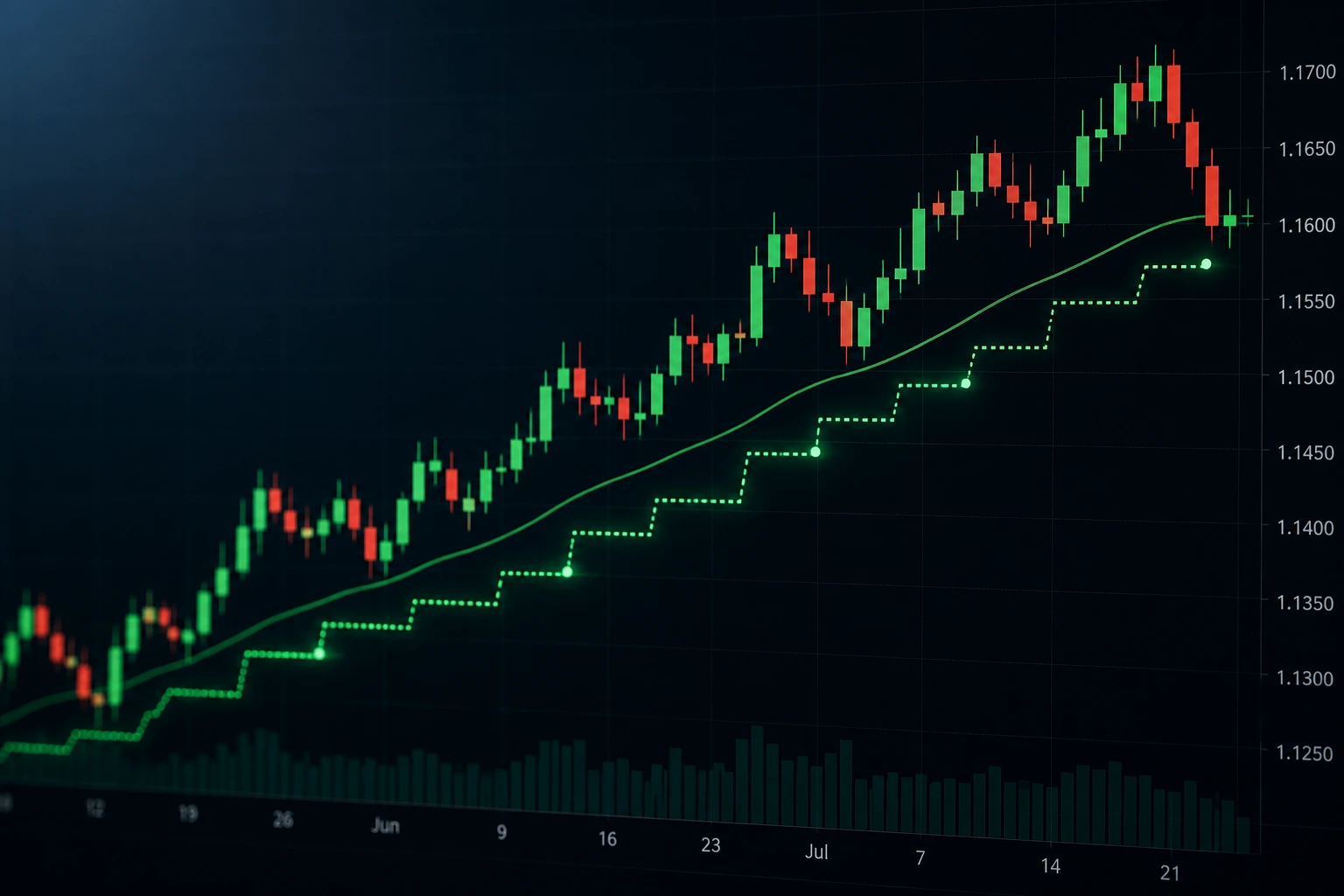
A trailing stop looks simple on paper: the market moves in your favor, so the stop loss moves with it.
But in a real Expert Advisor, a reliable trailing-stop system is much more than subtracting a fixed number of points from the current price.
A production-quality implementation has to decide when trailing should start, how often the stop should move, how far behind price it should remain, and whether the new stop is actually valid according to the broker's trading rules.
Done correctly, trailing logic can allow profitable trades to breathe while progressively reducing open risk. Done poorly, it can destroy an otherwise good strategy by closing positions during normal market noise.
In this article, we will build the logic from the ground up and then look at more practical approaches such as activation thresholds, step-based trailing, broker validation, and ATR-driven stop management.
What a Trailing Stop Actually Does
A trailing stop is a dynamic stop-loss mechanism that only moves in the direction of the profitable trade.
For a BUY position:
Market moves higher  → Stop Loss can move higher

Market moves lower   → Stop Loss stays unchanged
For a SELL position, the logic is reversed:
Market moves lower   → Stop Loss can move lower

Market moves higher  → Stop Loss stays unchanged
The important part is that the stop should never move backwards and increase the original risk.
Once profit has been protected, that protection should normally remain in place.
Why Trailing Logic Matters More Than It Seems
Many automated systems are built around a fixed stop loss and a fixed take profit.
That structure is predictable, but it can become restrictive when the strategy is designed to capture extended directional moves.
Imagine a breakout EA enters a trade before a strong trend begins.
A fixed 50-pip take profit may close the position correctly according to the original rules, but the market could continue another 150 pips afterward.
A trailing system provides another option: instead of predicting exactly where the move should end, the EA can manage the trade while the trend remains favorable.
A well-designed trailing stop can help:
- reduce open risk as a trade develops
- lock in part of an existing profit
- allow strong trends to continue beyond a fixed target
- standardize trade management without manual intervention
- adapt exit behavior to the movement of the market
But trailing does not automatically improve every strategy.
The exit logic has to fit the behavior of the entry model.
The Most Basic Trailing-Stop Rule
Suppose we have a BUY position and want the stop to stay 150 points behind the current Bid price.
Conceptually:
new_stop = Bid - trailing_distanceBut calculating the level is only the first step.
Before modifying the position, the EA should verify that:
- the position still exists
- the position belongs to the intended symbol or strategy
- the trade has reached the required profit level
- the calculated stop is better than the existing stop
- the stop respects the symbol's minimum stop distance
- the price is normalized correctly for that instrument
- the modification is significant enough to justify a new request
This is why trailing-stop logic deserves its own trade-management module rather than being scattered through the main strategy code.
A Clean Fixed-Distance Example in MQL5
The following simplified example demonstrates the core idea.
void UpdateTrailingStop(
   ulong ticket,
   double trailing_points
)
{
   if(!PositionSelectByTicket(ticket))
      return;

   string symbol =
      PositionGetString(POSITION_SYMBOL);

   ENUM_POSITION_TYPE type =
      (ENUM_POSITION_TYPE)
      PositionGetInteger(POSITION_TYPE);

   double current_sl =
      PositionGetDouble(POSITION_SL);

   double current_tp =
      PositionGetDouble(POSITION_TP);

   double bid =
      SymbolInfoDouble(symbol, SYMBOL_BID);

   double ask =
      SymbolInfoDouble(symbol, SYMBOL_ASK);

   double point =
      SymbolInfoDouble(symbol, SYMBOL_POINT);

   double new_sl = 0.0;


   // BUY position
   if(type == POSITION_TYPE_BUY)
   {
      new_sl =
         bid - trailing_points * point;

      if(current_sl == 0 || new_sl > current_sl)
      {
         trade.PositionModify(
            ticket,
            new_sl,
            current_tp
         );
      }
   }


   // SELL position
   if(type == POSITION_TYPE_SELL)
   {
      new_sl =
         ask + trailing_points * point;

      if(current_sl == 0 || new_sl < current_sl)
      {
         trade.PositionModify(
            ticket,
            new_sl,
            current_tp
         );
      }
   }
}
Notice that the current Take Profit is preserved during the modification.
This is important because a trade-management function should not accidentally remove another part of the position configuration while updating the stop loss.
The First Major Improvement: Trailing Activation
Starting the trailing stop immediately after entry is often too aggressive.
A freshly opened trade usually needs some room to fluctuate before the expected move develops.
Instead, we can separate the system into two values:
- Activation Distance — how much profit is required before trailing begins
- Trailing Distance — how far the stop remains behind the current market price
For example:
Activation: 200 points
Trailing:   100 points
The EA does nothing while the position is below 200 points of open profit.
Once the threshold is reached, the trailing mechanism becomes active.
if(profit_points >= activation_points)
{
   UpdateTrailingStop(
      ticket,
      trailing_points
   );
}
This small change can significantly alter the behavior of a strategy because the stop is no longer reacting to normal price movement immediately after entry.
Do Not Modify the Stop on Every Tiny Price Change
Another common mistake is sending a new stop-loss modification every time the market moves by one point.
That produces unnecessary trade requests and offers almost no practical benefit.
A better design introduces a trailing step.
For example:
Activation Distance = 200 points
Trailing Distance   = 100 points
Trailing Step       = 50 points
The stop now moves only when the new calculated level improves the current stop by at least 50 points.
For a BUY position:
if(new_sl >= current_sl + trailing_step * point)
{
   ModifyStopLoss(...);
}
This creates a cleaner progression:
Initial SL
    ↓
Profit threshold reached
    ↓
Trailing activated
    ↓
Price advances
    ↓
Stop moves one step
    ↓
Price advances again
    ↓
Stop moves another step
The EA reacts to meaningful movement instead of every market fluctuation.
Broker Stop Levels Must Be Respected
A calculated stop can be logically correct and still be rejected by the broker.
MetaTrader symbols can define a minimum distance between the current market price and protective orders.
In MQL5 this can be queried using:
long stops_level =
   SymbolInfoInteger(
      symbol,
      SYMBOL_TRADE_STOPS_LEVEL
   );
The distance can then be converted to price:
double minimum_distance =
   stops_level * point;
For a BUY position, the new stop should not be too close to the Bid.
For a SELL position, it should not be too close to the Ask.
A robust system may also need to consider the symbol's freeze level before attempting a modification.
Ignoring these constraints can result in repeated rejected modifications even when the trailing calculation itself is correct.
Points, Pips, and Tick Size Are Not the Same Thing
Hardcoding assumptions about price precision is another common source of bugs.
Forex pairs, metals, indices, cryptocurrencies, and CFDs can have different price structures.
The EA should obtain symbol information directly from MetaTrader rather than assuming every market behaves like EURUSD.
Useful symbol properties include:
SYMBOL_POINT
SYMBOL_TRADE_TICK_SIZE
SYMBOL_DIGITS
SYMBOL_TRADE_STOPS_LEVEL
SYMBOL_TRADE_FREEZE_LEVEL
This becomes especially important when the same trade-management engine is expected to work across several instruments.
A trailing algorithm that appears perfect on a five-digit forex pair may need different normalization logic on gold or an index CFD.
Fixed Trailing vs Step Trailing
A fixed-distance trailing system continuously calculates a stop at a constant distance behind price.
A step-based system moves less frequently.
For example:
Price     Stop

1.1000    1.0950
1.1030    1.0950
1.1050    1.1000
1.1080    1.1000
1.1100    1.1050
The stop advances only after price reaches the next predefined step.
This type of logic can be useful when a strategy needs more stable trade management and does not benefit from reacting to every small price movement.
Break-Even and Trailing Should Usually Be Separate
Break-even logic and trailing-stop logic are related, but they are not necessarily the same thing.
A more flexible position manager can use several stages:
Stage 1
Position opens with initial risk

Stage 2
Minimum profit reached

Stage 3
Stop moves to break-even

Stage 4
Additional profit reached

Stage 5
Trailing system activates
For example:
Initial Stop Loss:     -150 points
Break-Even Activation: +200 points
Trailing Activation:   +350 points
Trailing Distance:      150 points
This gives the strategy time to develop before aggressive profit protection begins.
It also allows break-even behavior to be tested independently from trailing behavior.
ATR-Based Trailing: Let Volatility Define the Distance
A fixed trailing distance assumes that 100 points represent approximately the same amount of market noise all the time.
In reality, volatility changes.
A 100-point movement may be significant during a quiet session and almost meaningless during a high-volatility event.
One solution is to calculate the trailing distance from Average True Range (ATR).
In MQL5, iATR() creates an indicator handle:
int atr_handle =
   iATR(
      _Symbol,
      PERIOD_M15,
      14
   );
The current ATR value can then be retrieved with
CopyBuffer():
double atr_buffer[1];

if(
   CopyBuffer(
      atr_handle,
      0,
      0,
      1,
      atr_buffer
   ) == 1
)
{
   double atr = atr_buffer[0];
}
A BUY trailing stop could then be calculated conceptually as:
new_sl =
   bid - atr * atr_multiplier;
For example:
ATR Multiplier = 1.5When volatility expands, the stop automatically receives more room.
When the market becomes quieter, the trailing distance contracts.
Why ATR Trailing Can Be Useful on XAUUSD and Indices
Markets such as XAUUSD, NAS100, and other volatile instruments can move through very different volatility regimes.
A fixed 100-point trailing distance may work during one session and become completely inappropriate during another.
ATR provides a way to express stop distance relative to recent market movement instead of a permanently fixed number.
This does not mean ATR trailing is automatically superior.
The ATR period, timeframe, multiplier, activation logic, and strategy type all still require testing.
But for systems trading instruments with large changes in volatility, it provides a much more flexible foundation.
Trailing Based on Market Structure
Distance-based trailing is not the only approach.
More advanced systems can move the stop according to actual market structure.
For a long position, the stop could follow:
- recent swing lows
- previous candle lows
- moving averages
- support zones
- volatility bands
Instead of asking:
How many points should the stop stay behind price?
the strategy asks:
Which market level would invalidate the current trade structure?
That creates a very different type of exit system.
A Professional Position Manager Should Be Modular
In larger Expert Advisors, trailing logic should not be hardcoded inside the entry strategy.
The entry engine may simply create the position.
A separate position-management module can then decide how that trade should be managed.
Conceptually:
Position Manager
│
├── Initial Stop Management
├── Break-Even Module
├── Partial Close Module
├── Trailing Stop Module
├── Time-Based Exit Module
└── Emergency Risk Controls
This has an important advantage:
the same entry strategy can be tested with several different exit models without rewriting the signal logic.
For example:
- fixed TP only
- break-even + fixed TP
- step trailing
- ATR trailing
- structure trailing
Exit management becomes a configurable component rather than part of one giant trading function.
Do Not Manage Every Position on the Account
An EA should also identify which positions actually belong to it.
If the account contains manual trades or positions created by another Expert Advisor, the trailing module should not modify them accidentally.
Position filtering can consider:
- symbol
- magic number
- position type
- strategy identifier
This becomes critical when multiple automated systems operate on the same trading account.
Modification Results Should Always Be Checked
Calling PositionModify() does not mean the modification should be
treated as successfully completed without verification.
Trade-management code should inspect the execution result and log failures with enough context to understand what happened.
A useful log might look like:
[EURUSD][TRAIL]
Old SL: 1.08750
New SL: 1.08900
Result: Modified successfully
Or:
[XAUUSD][TRAIL]
Modification rejected
Reason: Stop level too close to market
Structured logs are extremely useful when a trailing algorithm behaves differently in live trading than expected from testing.
When Trailing Stops Work Best
Trailing stops are particularly useful in strategies designed to capture extended directional movement.
Common examples include:
- trend-following systems
- breakout Expert Advisors
- swing-trading strategies
- momentum systems
- volatility-expansion strategies
But they may be less suitable for strategies where the expected edge depends on a precise exit target.
Examples can include:
- very short-term scalping
- some mean-reversion systems
- grid structures
- certain basket-management strategies
The important question is not:
Is trailing stop good?
The better question is:
Does this trailing model match the statistical behavior of this strategy?
How Trailing Logic Should Be Tested
Testing only one trailing distance is rarely enough.
The interaction between several parameters should be evaluated:
- activation distance
- trailing distance
- trailing step
- break-even threshold
- ATR period
- ATR multiplier
- timeframe
More importantly, do not judge the result only by net profit.
Compare metrics such as:
- average winning trade
- maximum adverse excursion
- maximum favorable excursion
- profit factor
- drawdown
- average trade duration
- percentage of profits given back before exit
A tighter trailing stop may increase the number of profitable trades while reducing the size of the best winners.
A wider stop may create fewer successful trades but allow major trends to produce substantially larger returns.
There is no universally correct setting.
A Better Way to Think About Trailing Stops
A trailing stop should not be viewed as a feature that simply moves an SL.
It is an exit engine.
Its job is to answer a more important question:
How much room should a profitable trade be given before the market has moved enough against our position to justify an exit?
That decision can be based on:
- fixed distance
- profit milestones
- volatility
- market structure
- indicator values
- time in trade
- a combination of several conditions
Once trailing is treated as part of the strategy architecture rather than a small add-on, much more robust trade-management systems become possible.
Final Thoughts
The code required to move a stop loss is easy.
The difficult part is deciding when, where, and how often that stop should move.
A well-designed MQL5 trailing system should:
- never increase the original trade risk
- activate only when the strategy requires it
- avoid unnecessary modification requests
- respect broker and symbol constraints
- preserve existing position parameters
- work correctly across different instrument specifications
- support volatility-aware or structure-based management when needed
- produce clear logs when a modification succeeds or fails
For simple systems, fixed-distance trailing may be enough.
For more advanced Expert Advisors, trailing can become an independent trade-management engine containing break-even rules, step logic, ATR adaptation, partial exits, structural stops, and portfolio-aware controls.
The difference is not the number of lines of code.
It is whether the exit logic has been designed deliberately.
Advanced Trade Management with FLECTA
FLECTA develops custom MQL4 and MQL5 Expert Advisors with modular trade-management systems built around the requirements of the strategy.
Fixed trailing, step-based trailing, ATR-driven stops, break-even management, partial closing, market-structure exits, and custom risk rules can be combined into a single position-management architecture when the project requires more than a basic stop-loss implementation.
For complex automated strategies, trade management should be designed with the same care as the entry logic itself.
Comments 0
Questions, technical notes, and useful additions are welcome.
Be the first to leave a useful note about this article.
Leave a comment
Your comment may be reviewed before it appears publicly.